AI voice bots are transforming how businesses talk to customers. With AI call center solutions, companies can move beyond long wait times, missed calls, and repetitive questions, offering fast, natural, and helpful voice conversations at any time of day. An AI‑powered contact center for better agent results ensures higher customer satisfaction, lower costs, and allows human agents to focus on high‑value, complex interactions. Today, AI voice bots are also integrated with advanced cloud computing platforms and modern computer technology, giving companies access to scalable infrastructure, real-time customer analytics, and intelligent automation tools. These systems can support digital marketing strategies, including AI-driven marketing campaigns, personalized customer engagement, predictive audience targeting, and content optimization. In finance, AI-powered voice systems help streamline automated payment solutions, financial reporting, and intelligent risk management, connecting customer interactions directly to smarter business decision-making. By combining AI voice bots with cloud-based software, big data insights, and machine learning algorithms, companies can unify customer support, digital marketing initiatives, and financial operations into one seamless, technology-driven experience, creating more meaningful interactions and measurable results across all areas of business
Top 10 AI Voice Bots and Contact Center Solutions for Smarter Customer Support
1. Bright Pattern – AI Contact Center Solutions for Modern Businesses
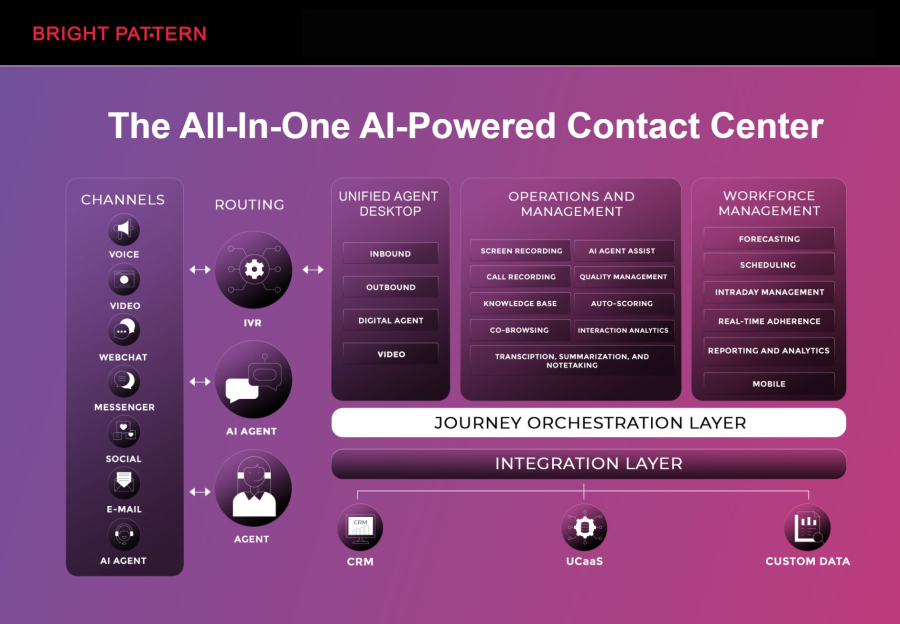
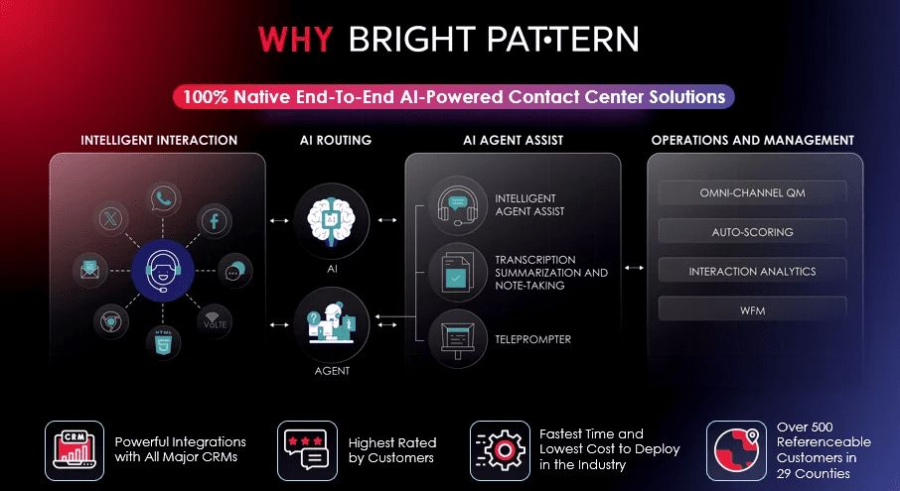
Bright Pattern stands out as a top provider of AI voice bots and AI contact center solutions, helping businesses streamline customer interactions and improve agent performance. Their platform combines intelligent voice automation with multichannel communication, making it easier to manage high volumes of customer inquiries while enhancing overall satisfaction.
Why Bright Pattern Leads the Industry:
- AI-Powered Automation: Automates routine calls, FAQs, and follow-ups while freeing agents for complex tasks.
- Omnichannel Support: Handles voice, chat, SMS, email, and social channels in a single platform.
- Cloud-Based Flexibility: Enables seamless scaling and integration with existing CRM and business systems.
- Real-Time Analytics: Offers actionable insights to improve agent efficiency and customer experience.
- Customizable Workflows: Allows businesses to design AI-assisted call flows tailored to specific needs.
Bright Pattern’s AI voice bots not only reduce operational costs but also enhance the quality of customer service by delivering fast, natural, and accurate voice interactions. Their solutions are ideal for enterprises looking to implement AI-driven call center technology without compromising human agent engagement.
2. Five9 – Cloud Contact Center Software
Five9 provides intelligent call routing and AI-driven automation to improve customer service efficiency. Its AI voice bots help streamline repetitive tasks, while predictive analytics guide agent performance.
3. Genesys Cloud CX – AI-Enhanced Customer Experience
Genesys combines AI-powered automation with omnichannel support, helping businesses deliver personalized experiences across voice, chat, and digital channels.
4. NICE inContact – AI Call Center Platform
NICE inContact offers AI-enabled voice bots that manage routine interactions and provide supervisors with real-time performance insights to optimize agent efficiency.
5. Talkdesk – AI Contact Center for Intelligent Automation
Talkdesk integrates machine learning with AI voice bots, automating customer service workflows and offering predictive call handling to improve response times.
6. 8x8 Contact Center – Cloud AI Voice Solutions
8x8 uses AI voice bots and cloud technology to deliver multichannel contact center solutions, helping businesses reduce wait times and improve first-call resolution.
7. RingCentral Contact Center – AI Customer Engagement
RingCentral provides AI-powered voice interactions and analytics to streamline agent workflows and enhance customer satisfaction across multiple communication channels.
8. Cisco Contact Center – AI and Automation for Enterprises
Cisco’s AI contact center solutions integrate voice bots and advanced analytics to help large organizations manage high call volumes efficiently.
9. Avaya OneCloud CCaaS – AI-Driven Customer Support
Avaya’s AI voice bots support intelligent call routing, automated responses, and analytics, helping businesses optimize their contact center operations.
10. Freshworks Contact Center – AI Voice and Digital Support
Freshworks offers AI voice bots and smart automation tools for call centers, enabling seamless handling of customer interactions across voice and digital platforms.
What Is an AI Voice Bot?
AnAI voice botis a software application that uses artificial intelligence to understand spoken language and respond with a synthetic voice. It is the voice equivalent of a chatbot, but instead of typing, customers simply speak as they would to a human agent.
Unlike traditional interactive voice response systems, which rely on rigid menus like “Press 1 for sales,” AI voice bots can understand natural sentences such as “I want to update my shipping address” or “Can you tell me my current balance?” and respond in a conversational way.
Key Capabilities of Modern AI Voice Bots
- Speech recognitionto convert the caller’s voice into text the system can process.
- Natural language understandingto figure out the intent and key details in what the caller says.
- Dialogue managementto decide what to say next and guide the conversation.
- Backend integrationsto connect with CRMs, ticketing systems, payment gateways, or booking tools.
- Text‑to‑speechto convert the bot’s response into a natural‑sounding voice.
When these elements work together, the result is a smooth, human‑like interaction that can handle thousands of calls in parallel.
How AI Voice Bots Work: A Simple Breakdown
Behind every seemingly effortless conversation is a structured process. Here is what typically happens when someone calls and speaks to an AI voice bot:
- The caller speaks.The system captures the audio in real time.
- Speech is converted to text.Automatic speech recognition (ASR) transforms voice into written words.
- The intent is detected.Natural language understanding (NLU) analyzes the text to determine what the caller wants and extracts key entities such as dates, amounts, or names.
- The bot decides how to respond.A dialogue manager chooses the next step: answer a question, ask for clarification, trigger a workflow, or route to a human.
- Systems are updated.If needed, the bot connects to internal systems to retrieve information or perform an action, such as updating an address or checking an order status.
- Text is converted to speech.Text‑to‑speech (TTS) technology turns the response into realistic, natural‑sounding audio.
- The caller hears the reply.The exchange continues until the caller’s need is satisfied or the call is handed off to a human agent.
All of this happens in a fraction of a second, creating the impression of a live, intelligent assistant on the other end of the line.
Business Benefits of AI Voice Bots
AI voice bots are not just “nice to have.” They deliver concrete, measurable value across customer experience, operations, and revenue.
1. 24/7 Availability Without Extra Staffing
Customers increasingly expect help at any time. With an AI voice bot, your phone line can stay open 24 hours a day, 7 days a week, including weekends and holidays, without hiring night shifts or seasonal staff.
- Handle common requests outside office hours.
- Provide urgent information instantly, even at midnight.
- Ensure customers never hear “We are currently closed.”
2. Shorter Wait Times and Faster Resolutions
Long queues frustrate customers and hurt satisfaction. AI voice bots can engage callers immediately, collect details, and often solve their problems on the spot.
- Answer calls instantly, even during peak demand.
- Resolve frequent, simple requests fully through automation.
- Pre‑qualify and triage complex issues before transferring to an agent.
The result is a smoother experience for callers and less pressure on human teams.
3. Lower Operating Costs
Handling every call with human agents alone can become expensive as you grow. AI voice bots allow you to scale call handling without proportional increases in staffing and training costs.
- Automate repetitive, high‑volume questions and tasks.
- Reduce average handling time by gathering information upfront.
- Enable smaller teams to support a larger customer base efficiently.
Instead of constantly expanding call center headcount, you can use AI to absorb repetitive workloads and focus your budget where human expertise adds the most value.
4. Consistent, Compliant Conversations
Human agents may phrase answers differently or occasionally forget a step in a required script. An AI voice bot, by contrast, delivers consistent responses every time based on your defined rules and content.
- Ensure key disclosures and compliance wording are always included.
- Standardize answers to frequently asked questions.
- Reduce the risk of errors in regulated environments.
You stay in control of what is said and how it is phrased, creating a reliable and predictable customer experience.
5. Happier Agents and Higher‑Value Work
When AI voice bots take over routine questions and repetitive tasks, human agents are freed to focus on higher‑value work that requires empathy, negotiation, or specialized knowledge.
- Agents spend less time repeating the same information.
- More energy goes into complex problem‑solving and relationship building.
- Work feels more meaningful, which can improve morale and retention.
This human‑AI partnership can transform your contact center from a cost center into a strategic asset.
High‑Impact Use Cases for AI Voice Bots
AI voice bots can support a wide range of industries and functions. Here are some common and high‑value applications.
Customer Service and Support
- Answer frequently asked questions about products, pricing, or policies.
- Provide order status, shipment tracking, or account details.
- Help customers reset passwords or unlock accounts via secure flows.
- Guide callers through troubleshooting steps for common issues.
Sales and Lead Qualification
- Respond to inbound sales calls and capture lead information.
- Qualify prospects by asking key questions and scoring their fit.
- Route hot leads to the right sales representative in real time.
- Follow up on missed calls and invite prospects to schedule appointments.
Appointments, Bookings, and Reservations
- Let customers book, reschedule, or cancel appointments by voice.
- Send confirmations and reminders through your existing systems.
- Reduce no‑shows with timely, automated reminder calls.
Banking, Insurance, and Financial Services
- Provide balance, transaction summaries, and payment due dates.
- Help customers update details like addresses or contact numbers.
- Guide callers through claims initiation or loan pre‑qualification flows.
Healthcare and Patient Support
- Handle appointment scheduling, rescheduling, and basic triage questions.
- Share clinic hours, location information, and preparation instructions.
- Support medication reminders or follow‑up call campaigns.
Industry Use Case Snapshot
|
Industry |
Typical Voice Bot Use Case |
Main Benefit |
|
Retail & E‑commerce |
Order tracking, returns, store info |
Fewer support tickets, happier shoppers |
|
Banking & Fintech |
Balance checks, card issues, payment info |
Improved security and reduced call center load |
|
Healthcare |
Appointments, reminders, FAQs |
Better patient access, reduced no‑shows |
|
Travel & Hospitality |
Booking changes, check‑in info, loyalty queries |
Smoother journeys and higher loyalty engagement |
|
Utilities & Telecom |
Outage info, billing, plan details |
Deflected calls and faster resolutions |
Essential Features to Look for in an AI Voice Bot
If you are evaluating AI voice bot solutions, certain capabilities will make or break long‑term success.
1. High‑Accuracy Speech Recognition
The quality of the conversation starts with how accurately the system can understand callers. Look for speech recognition that performs well across accents, background noise, and natural speech patterns, not just slow, clear sentences.
2. Natural, Human‑Like Voices
Voice quality strongly influences how customers perceive your brand. Modern text‑to‑speech engines can produce voices that sound warm, engaging, and close to human. Ideally, you should be able to choose from multiple voices and adjust tone to match your brand personality.
3. Strong Natural Language Understanding (NLU)
Good NLU helps the bot handle variations like “I lost my card,” “My card is missing,” or “Somebody stole my card” as the same intent. It should capture important details such as dates, amounts, or product names, not just keywords.
4. Omnichannel and System Integrations
An effective AI voice bot does not operate in isolation. It should integrate with:
- Customer relationship management systems.
- Ticketing and help desk tools.
- Payment or billing platforms.
- Booking or scheduling tools.
These integrations allow the bot to perform useful actions, not just give generic answers.
5. Easy Configuration and Analytics
You should be able to design conversational flows, update content, and tweak logic without always relying on developers. Equally important, performance analytics should show:
- Containment rate (how many calls are handled fully by the bot).
- Average handling time and time saved for agents.
- Drop‑off points and common failure reasons.
These insights help you continuously refine and improve the experience.
6. Secure, Privacy‑Aware Architecture
Voice interactions often involve sensitive information. Strong security and data protection are essential, including:
- Encryption in transit and at rest for call data.
- Access controls and role‑based permissions.
- Clear data retention and deletion policies.
By design, your AI voice bot strategy should respect user privacy and meet relevant regulatory requirements for your region and industry.
Implementing an AI Voice Bot: Step‑by‑Step Roadmap
Launching a successful AI voice bot does not have to be overwhelming. A structured approach allows you to start small, demonstrate value, and scale with confidence.
Step 1: Define Clear Goals and Metrics
Begin by deciding what success looks like. Examples include:
- Reducing average wait time by a specific percentage.
- Automating a defined portion of calls such as order tracking or appointment management.
- Improving customer satisfaction scores for phone support.
Clear goals will guide your design and help evaluate impact.
Step 2: Choose the Right Use Cases
Start withhigh‑volume, low‑complexity interactionswhere automation is safest and most impactful, for example:
- Order status or delivery updates.
- Business hours, location, and basic informational queries.
- Simple account checks after authentication.
These early wins build trust and momentum across your organization.
Step 3: Map the Conversation Flows
Before building, sketch out how typical calls should go. Identify:
- The opening greeting and brand tone.
- Questions to ask and information to collect.
- How to confirm understanding and handle misunderstandings.
- When and how to transfer to a human agent.
Well‑thought‑out flows reduce friction and keep callers from getting stuck.
Step 4: Integrate with Your Systems
Connect the voice bot with the systems it needs to access so it can perform meaningful tasks. For example:
- Pull order details from your order management system.
- Write notes into your customer relationship management tool.
- Trigger workflows in your support or ticketing platform.
These connections turn the bot from a talking FAQ into a true virtual assistant.
Step 5: Test with Real Users
Internal testing is helpful, but the most valuable feedback comes from real callers. Run a pilot with a subset of calls or specific use cases and watch how people interact with the bot.
- Listen to call recordings or transcripts.
- Identify where callers get confused or drop off.
- Refine the wording, prompts, and fallback strategies.
Iterative improvements quickly lift both containment and satisfaction.
Step 6: Launch, Monitor, and Improve
Once the bot is live, treat it as a living product. Regularly review metrics, update knowledge, and add new use cases as you see patterns in customer behavior. The more it learns and evolves, the more value it delivers.
Best Practices for Customer‑Friendly AI Voice Bots
Technology alone does not guarantee a great experience. These practical guidelines help you design AI voice bots that people actually enjoy using.
Be Transparent That It Is a Bot
Set expectations from the first interaction. A simple introduction such as “You are speaking with our virtual assistant” builds trust and reduces frustration. Callers still appreciate speed and convenience, even when they know they are talking to an AI.
Offer Easy Escalation to Humans
There will always be situations where callers want a human. Make it easy to say things like “speak to an agent” and be transferred quickly. A smooth handoff that includes call context makes the experience feel seamless.
Use Conversational, Natural Language
Avoid robotic or overly formal wording. Write prompts the way a helpful human agent would speak, using clear, simple language. Short, focused questions are easier for callers to answer and for AI to understand.
Design for Misunderstandings
Even advanced systems occasionally mishear or misinterpret. Plan for these moments with graceful fallbacks:
- Politely ask callers to repeat or rephrase.
- Summarize what the bot understood and confirm.
- Transfer to a human if multiple attempts fail.
Handling confusion well is often more important than getting everything right on the first try.
Continuously Refresh Content and Training Data
Customer questions change over time as your products, services, and policies evolve. Make sure your AI voice bot keeps up by:
- Adding new intents when you spot emerging topics.
- Retiring outdated information or flows.
- Training on real call transcripts to capture authentic phrasing.
A dynamic content strategy keeps your bot relevant and helpful.
The Future of AI Voice Bots
AI voice technology is advancing rapidly. Over the coming years, you can expect:
- More natural conversation flowswith fewer pauses and smoother turn‑taking.
- Richer personalizationas bots use context from previous interactions and customer history.
- Deeper emotion awarenesswhere systems can detect frustration or confusion and adjust their approach.
- Expanded use beyond supportinto proactive outreach, loyalty programs, and tailored recommendations.
Businesses that begin experimenting with AI voice bots now will be well positioned to take advantage of these capabilities as they mature.
Frequently Asked Questions About AI Voice Bots
Will AI voice bots replace human agents?
AI voice bots are best viewed as partners to human agents, not replacements. They handle routine, repetitive tasks and basic questions, while humans focus on complex, emotionally sensitive, or high‑value conversations. This combination delivers higher quality service at a lower cost.
How quickly can an AI voice bot start delivering value?
Timelines vary, but many organizations see benefits within weeks when they start with focused, well‑defined use cases such as order tracking or appointment scheduling. Early wins create a foundation for broader adoption.
Are customers comfortable talking to AI?
Customer comfort depends largely on the quality of the experience. When interactions are fast, accurate, and respectful, many people prefer AI for simple tasks because it saves time. Clear communication and easy access to human help further increase acceptance.
Do AI voice bots support multiple languages?
Many modern AI voice solutions support multiple languages and can recognize different accents. Language availability and performance vary, so it is important to confirm that your key markets and language combinations are supported before rollout.
What kind of maintenance do AI voice bots require?
After launch, you will want to review analytics, listen to sample calls, and periodically update scripts and training data. This ongoing tuning helps your bot stay aligned with changing customer needs and business priorities while steadily improving performance.
AI voice bots are reshaping how organizations communicate. By automating routine calls, accelerating service, and empowering agents, they unlock a more responsive, efficient, and enjoyable customer experience. With clear goals, thoughtful design, and continuous improvement, your business can turn every phone call into an opportunity to impress.
